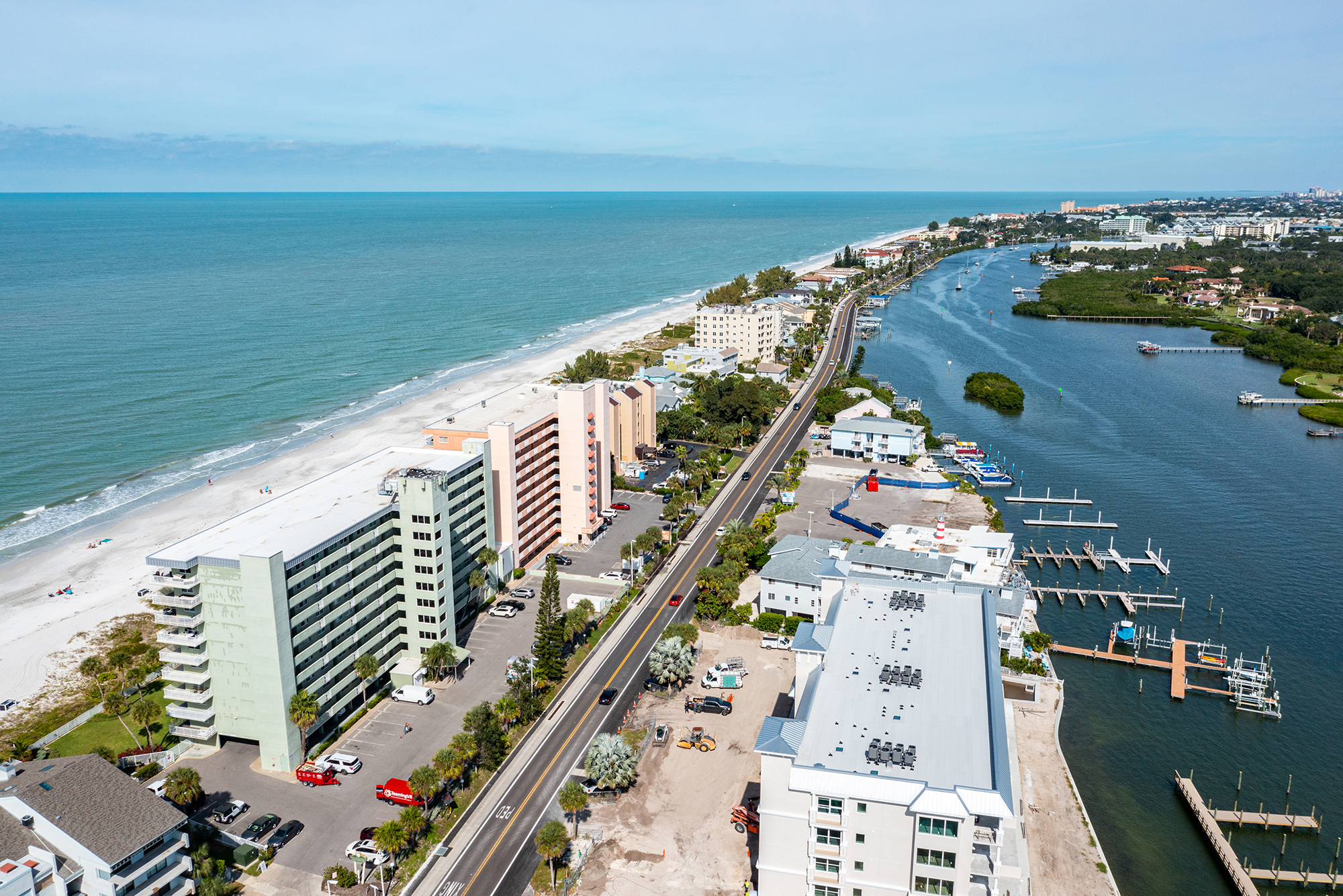
If you own a vacation rental condo on the Pinellas Gulf Beaches, you have probably done the quiet math on your phone at night. Zillow says one thing, your gut says another, and the number you paid, whether that was at the 2023 peak, with a 3% mortgage in 2021, or a decade or more ago, sits in the back of your mind. I want to give you something better than a guess: the actual closed-sale record of one floor plan, in one weekly-rental building in Indian Shores, sold six times in five years. I represented the buyers in the most recent sale, so these are numbers I know firsthand.
Here is what the identical 2-bedroom, 2-bath, 1,390-square-foot floor plan closed for, per StellarMLS: $550,500 in September 2021, $659,000 in November 2022, $670,000 in April 2023, $695,000 in June 2023, then $550,000 in May 2026 and $538,000 in August 2026. The full transaction breakdown, including the cash flow math, is in my Indian Shores case study on the price reset.
Same unit. Same rental rights. Prices round-tripped to 2021 in five years, and the June 2023 buyer is looking at roughly $157,000 less than they paid, about 22.6%.
That is a hard number to read if you bought at the peak. So let me walk you through what it actually means for you, the way I would on the phone, risk first, then the real options.
How much have Pinellas Gulf Beach vacation rental condo prices dropped since the 2023 peak?
In the Indian Shores building I track most closely, the identical condo floor plan fell from a $695,000 peak in June 2023 to $538,000 in August 2026, a decline of about 22.6%, per StellarMLS closed sales. Statewide averages show smaller declines, which is exactly why building-level closed comps, not county or state numbers, are the only honest basis for valuing a specific Gulf Beach condo.
Compared to what you hear on the news, that drop sounds extreme. Compared to what actually closed in the building, it is simply the market. One unit in that building sold over asking in 3 days in 2021. The August 2026 sale took 425 days and closed at 94% of its original list price. The market did not just reprice, it slowed down, and time on market is its own cost when the association fee is $1,120 a month.
Why do 2021 buyers and 2022-2023 buyers face completely different decisions?
Two numbers separate the cohorts: entry price and mortgage rate. Average 30-year fixed rates sat near 3% through 2021, crossed 5% by April 2022, and approached 7% by October 2022, per the Freddie Mac Primary Mortgage Market Survey. A 2021 buyer bought below today’s prices with financing that cannot be replaced, so holding is typically their stronger position. A 2022-2023 buyer paid peak prices and now holds compressed equity.
If you bought in 2021 or earlier, your decision is mostly about life, not the market. Selling means giving up a 3%-range mortgage, and that is a real cost, but it also means you sell from strength: your equity is intact, your timeline is your own, and well-priced units from low-basis sellers are the ones buyers compete for. And if you have owned for a decade or more, the reset trimmed the top off a large gain, not your principal. Your questions are different: timing, taxes, possibly a 1031 exchange, and whether the income still earns its keep for your family. The same building-level review answers those too.
If you bought in 2022 or 2023, your decision starts with facts you may not have yet: the most recent closed comps in your actual building, your trailing-12-month rental income, and your true carrying costs after the fee increases. In the building above, association fees recorded on the listings rose from about $509 a month in 2021 to $1,058 to $1,120 a month in 2026. That is roughly $7,300 a year in new fixed cost on the identical unit, before a single guest checks in.
“The peak was 2023. Bookings have been down since Hurricane Helene, costs are up, and a new buyer’s debt service at six and a half percent rarely lets a financed condo cash flow right now. The 2021 owners can hold. The 2022 and 2023 buyers are the ones who need real numbers before they decide anything.”
Cyndee Haydon, Broker Associate, Sandbars to Sunsets Team with Future Home Realty
Will my vacation rental condo cash flow for a buyer at today’s rates?
For most financed buyers, no, and the income year you assume decides the size of the gap. At the August 2026 Indian Shores price of $538,000 with 20% down at 6.5%, principal and interest plus association fees total $46,085 per year. At the roughly $40,000 the unit’s rentals tracked over the last two years, the buyer contributes about $14,000 annually before taxes and insurance, after management at around 20 percent. At the unit’s established $60,000 income level, it comes close to breaking even.
This matters to you as a seller because it defines who your buyer is. Your buyer in 2026 is probably not a spreadsheet investor chasing pure cash flow. Your buyer is a family that wants a Gulf Beach place they will actually use, with rental income offsetting most of the cost, or a cash buyer, or someone putting far more than 20% down. Notice the pattern in the building’s record: the June 2023 peak sale and the May 2026 sale were both cash.
The buyers I represented in the August 2026 purchase knew all of this going in. We had a frank conversation before they offered, and I put it in writing during their due diligence period: the listing recorded verified income exceeding $63,000, the unit’s established history ran near $60,000, and the last two years tracked closer to $40,000 after Hurricane Helene. All three numbers are true, they just describe different years. We spent the due diligence period on the complete condo documents, budgets, reserve studies, insurance, and 12 months of minutes and agendas, and they decided with everything on the table. The milestone inspection and SIRS were both good, and every assessment was paid by the seller with none carrying forward. They bought a 2021 price with 2026 weekly rental rights, rental-ready with the furnishings left in place by the out-of-state sellers, and they are positioned for the recovery instead of paying peak prices during one. We weighed both sides of the ledger together: the condo may cost them around $14,000 in the first year or so, but rents drive what investors will pay, and if income recovers toward $60,000, the floor plan’s own 2022-2023 closed range of $659,000 to $695,000 suggests the value could rise by $100,000 or more. That trade, a five-figure annual contribution against a possible six-figure equity gain, is one they were comfortable making with eyes open. They plan to self-manage, which keeps the management line in their pocket, cuts the contribution at trailing income to about $6,100 before taxes and insurance, and turns the established $60,000 level clearly positive. They also did the whole thing remotely, from the FaceTime walkthrough through inspections, negotiated repairs, and closing, while my team coordinated everything on the ground. The seller covered my compensation through negotiation, and my buyers still closed at the lowest price in the building in five years with a new water heater and completed electrical repairs. They found me the way most of my vacation rental clients do: referred by a repeat client who has bought and sold five short-term rentals with me over ten years, owns two today, and is shopping for a third.
What actually makes a vacation rental condo sell in this market?
Three things sold the August 2026 unit while a comparable unit sat: pricing to the most recent closed comp instead of the 2023 memory, verified rental income a buyer’s lender and spreadsheet can trust, and turnkey furnished condition that lets the buyer keep renting from day one. Sellers who deliver all three sell. Sellers who deliver none of them follow the market down with price reductions.
The turnkey point deserves more attention than it gets, because it never shows up in a comps table. Two condos can close at similar prices while one hands the buyer a working business, furniture, housewares, reviews, and an operating history, and the other hands them a project with tens of thousands in setup costs and months of lost revenue. If your unit is turnkey and renting, that is a genuine premium, and your marketing needs to prove it with numbers, not adjectives. One practical note for financed deals: furniture is personal property and typically stays outside the mortgage transaction, so the clean approach is handling furnishings outside the purchase contract. In the August 2026 sale, the out-of-state sellers simply left the furnishings behind for their own convenience rather than clearing out the condo before closing, and the rental kept operating without interruption. Keeping your booking calendar open through the sale helps too. Future stays are revenue your buyer can see, and my default lean with sellers is to keep the calendar open and stay flexible based on the buyer’s preference.
One more thing worth knowing when you interview agents: I do not manage vacation rentals after the sale. Some STR-focused agents earn ongoing management income from the property after closing, which can quietly shape the advice you get. I also represent my sellers as single agents under Florida law, owing my fiduciary duty to you alone, and when a buyer comes unrepresented there is no buyer agent fee, which helps my sellers net the most possible and removes any feeling of dual loyalties. Removing those conflicts means my only job is getting your sale right.
Can buyers still get a conventional loan on my Gulf Beach condo after the August 2026 rule change?
Only if your building passes Full Review. For loan applications dated on or after August 3, 2026, Fannie Mae eliminated its Limited Review and Freddie Mac its Streamlined Review under Lender Letter LL-2026-03 and Bulletin 2026-C, so every condo loan in a building with more than 10 units now requires a Full Review of the budget, reserves, insurance, and litigation. The reserve funding floor rises from 10% to 15% of the annual budget for applications dated on or after January 4, 2027, so a building budgeting under 15% is on the clock.
The August 2026 sale in this story closed with a conventional loan that qualified under Limited Review days before the pathway ended. A buyer applying today faces the full exam on any building over 10 units, regardless of down payment: the association budget, the reserve allocation and reserve study, insurance, and litigation. The building I sold is the counterexample that proves the point. Its milestone inspection was good, its Structural Integrity Reserve Study was good, and every assessment had been paid by the seller with nothing carrying forward. Those documents helped sell the unit.
Here is the part I want every Gulf Beach condo owner thinking about selling to hear. Ideally, you pull your association’s budget and reserve allocation before you ever list. If your association budgets less than 15% of its annual assessment income to reserves, your conventional buyer pool starts shrinking on January 4, 2027, when the new floor takes effect. Buildings that cannot pass Full Review sell to cash buyers, and cash buyers pay cash-buyer prices. This is worth exploring now, while there is still time for a board to adjust, not after your sale falls through in underwriting. I wrote a full seller briefing on the timeline, the Full Review checklist, and what boards can still do before January.
Is now a good time to buy a vacation rental condo on the Gulf Beaches?
For the right buyer, this is the best entry window since 2021: prices in the building above are back to 2021 levels while weekly rental rights, under Town of Indian Shores Sec. 110-388 and the building’s rules, remain intact. The buyers who win in 2026 pay cash or put substantial money down, value personal use alongside income, and buy verified numbers rather than projections.
Tourism is not just recovering, it set a record. Visit St. Pete-Clearwater announced on June 22, 2026 that the destination welcomed nearly 5 million spring visitors, 4.7 million of them from February through April, with the highest-ever Tourist Development Tax collection for the period. Nightly rates are still priced for occupancy while bookings catch up to visitation. Property managers have held rates down because someone renting beats no one renting. As demand returns, owners regain pricing power. That is the recovery case, and history here leans in its favor. The honest caveat: nobody can promise the timeline, so the annual contribution has to be money you can comfortably commit while you wait. One thing two decades on these beaches has taught me: breaking even has always been a challenge here, because property values run high relative to rents and the margins are slim. The return has come from equity, and the buyers who do best are historically the ones who also love using the place themselves. Buy it as a place your family wants to be, run the income honestly, and let the equity do what it has done here for decades.
Should I wait for prices to recover before selling my Gulf Beach condo?
Waiting is a real strategy only if your carrying costs, your fee trajectory, and your life plans support holding for years, not months. In the Indian Shores building above, fees rose roughly 120% in five years while prices fell, which means waiting is not free. Owners who need to sell within the next year are better served pricing to today’s closed comps now than carrying $1,100+ monthly fees while chasing the market down.
This is where I would push back on your own assumption, the same way I do on mine. “I will wait until I get my price back” quietly assumes fees stay flat, insurance stays flat, bookings recover on your schedule, your building keeps passing Full Review, and nothing in your life changes. Test each of those against your actual numbers. Sometimes the answer really is hold. Sometimes the honest math says the peak price is gone and the question is whether this year’s net or a hoped-for future net serves your family better.
What to do next
Whatever year you bought, if you want the real answer instead of a portal estimate, I will run your building’s closed comps, your income numbers, and your association’s reserve position with you, no obligation and no pressure toward either answer. If you are a buyer who likes the math above, the same data shows which buildings offer a 2021 price with 2026 rental rights.
Call or text me at (727) 710-8035, or start with the full Indian Shores price reset case study and the Indian Shores vacation rental seller FAQ.
Cyndee Haydon, CRS, ABR, SRS, RENE, RSPS, CLHMS, CIPS, SRES, is a Broker Associate with the Sandbars to Sunsets Team with Future Home Realty, License BK3142780. She has completed 435+ residential transactions and $230M+ in sales since 2005, including 150+ vacation rental and STR transactions, and has been a Gulf Beaches Resident Since 1991. She is RealTrends Verified 2026, ranked #723 in Florida out of 232,000 Realtors, serves as 2026 Treasurer of Florida Realtors and 2026 Chair of the NAR Regulatory Issues Forum, and is the creator of the Haydon SHORE™ STR Investment Framework. Sales data: StellarMLS closed-sale records, compiled August 2026. Rate history: Freddie Mac Primary Mortgage Market Survey. Tourism data: Visit St. Pete-Clearwater, June 22, 2026. Regulatory references: Fannie Mae Lender Letter LL-2026-03 and Freddie Mac Bulletin 2026-C. Cyndee Haydon does not manage vacation rentals after the sale. This article is not financial, tax, or legal advice.